Analysis of Wiring Differences Between Mitsubishi and Siemens Panels
1. Why Can’t Operator Panel Wiring Be Directly Applied Even When Both Use CNC Controllers?
For CNC machine builders and automation equipment procurement personnel, the choice of controller brand is not merely a matter of software interface differences. It also directly affects the operator panel, I/O configuration, and overall machine integration approach. Mitsubishi and Siemens are both mainstream CNC controllers, but they differ in signal logic, contact configuration, communication architecture, and engineering practices. If the assumption is that "a panel with the same specifications can be directly substituted," issues often arise during commissioning, such as non-functional buttons, incorrect indicator light behavior, inconsistent signal mapping, and even abnormal control performance or delivery delays.
2. Common Wiring Differences Between Mitsubishi and Siemens
1. Differences in I/O Point Definitions and Polarity
Functions on the operator panel, such as start, reset, emergency stop, mode switching, and indicator lights, must ultimately correspond to the input and output points of the CNC system. Mitsubishi and Siemens often have different specifications for I/O address allocation, input polarity, voltage conditions, and common-point design. If the controller-side logic requirements are not confirmed in advance and existing wire harnesses or terminal configurations are reused directly, situations may occur where button signals are triggered but the system does not respond, or where the output indicator logic is reversed.
2. Differences in Communication and Interface Architecture
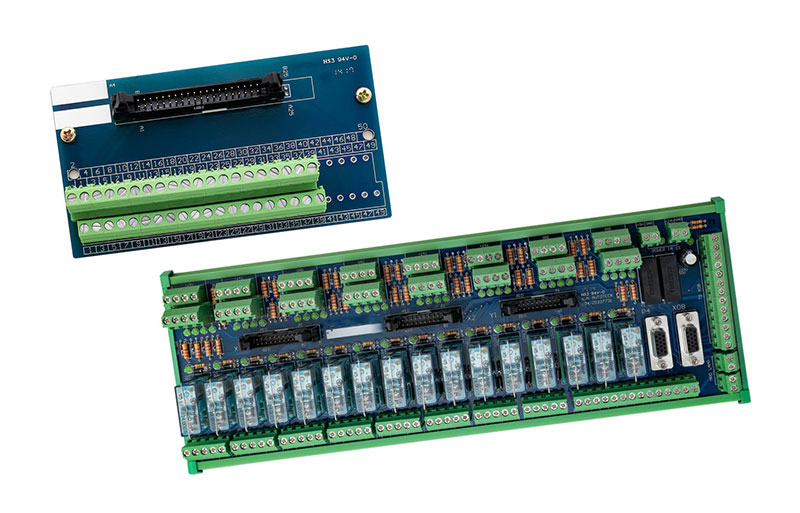
Some panels are more than just a collection of buttons and indicator lights; they may also integrate a handwheel, function board, I/O relay board, or dedicated interface board. Siemens systems typically impose stricter requirements on modularization, communication consistency, and engineering parameter settings. Mitsubishi systems, by contrast, more commonly use customized integration approaches in certain machine models and Asian market applications. This means that if the same panel is to be used across different systems, it is not enough to simply change the connector. Signal conversion, module compatibility, and data exchange methods must also be re-evaluated.
3. Differences in Physical Connectors and Wiring Practices
What is most often underestimated on site is the physical wiring detail. Connector types, terminal block layout, wire gauge selection, shielding requirements, labeling methods, and maintenance readability all affect subsequent installation and service efficiency. When Mitsubishi and Siemens systems are paired with different machine structures, engineering teams typically develop their own wiring conventions. When machines need to be upgraded, replaced, or exported to different markets, these differences can significantly increase integration costs.
3. Most Common Integration Pain Points in Practice
In new machine development and retrofit projects, common issues include mismatches between the panel function chart and actual wiring, the inability to find suitable replacements after the original controller is discontinued, failure to reuse existing PCBs or selector switches across different systems, and discovering only after pilot production that the button layout does not match the operator workflow. For procurement teams, the real risk is not just component pricing, but repeated modifications, machine downtime, and increased maintenance complexity. If a supplier only provides parts but cannot understand the machine’s control logic, the integration burden ultimately falls on the customer’s engineering team.
4. System Integration Requires More Than Matching Panel Appearance; Overall Electrical Compatibility Matters
A qualified operator panel must simultaneously meet requirements for operating habits, electrical conditions, mechanical installation, and long-term durability. In machine tool environments with oil contamination, vibration, metal chips, and frequent operation in particular, button structure, panel material, labeling method, and internal wiring stability all directly affect reliability. Therefore, when dealing with different systems such as Mitsubishi and Siemens, a better approach is not to force common use, but to carry out customized design based on controller characteristics so that the panel, circuit board, handwheel, and related interfaces are correctly matched from the beginning.
5. How 宇聯電子 Helps Reduce Cross-System Integration Risks
宇聯電子 has long been engaged in the design, manufacturing, and integration of machine tool electrical control products. With application experience in Mitsubishi, Siemens, Fanuc, Heidenhain, and other systems, Yeulian can customize operator panels, circuit boards, selector switches, and related control interfaces according to the customer’s machine model and control requirements. The key is not to provide a single standard product, but to clarify controller specifications, panel functions, installation conditions, and maintenance requirements at the early stage of the project in order to reduce downstream modification risks.
1. A Verification Process from Requirements to Mass Production
宇聯電子’s project workflow covers requirement confirmation, engineering feasibility assessment, proposal and quotation, design and development, sample production, machine testing, pilot run, and transfer to mass production. For replacement or upgrade projects, customers may also provide original product specifications, drawings, or circuit information for the engineering team to conduct compatibility review in advance. By applying verification concepts such as EVT, DVT, and PVT together with on-machine testing, issues related to wiring logic, interface configuration, and user experience can be identified earlier.
2. Balancing Stability and Maintenance Efficiency
For equipment procurement, a truly valuable solution is one that remains stable and maintainable after delivery. In its design process, 宇聯電子 emphasizes wiring clarity, interface compatibility, on-site operational convenience, and mass production consistency, helping customers retain flexibility in system integration, replacement part implementation, and subsequent maintenance. This is especially important for manufacturers that need to plan across multiple controller brands or handle both new machine development and legacy machine refurbishment at the same time.
6. Conclusion
The wiring differences between Mitsubishi and Siemens operator panels reflect two distinct control architectures and engineering logics. For CNC machine builders and automation equipment procurement personnel, identifying these differences early is the key to avoiding the misconception that only the panel is being changed, when in fact the entire system integration is affected. If the goal is to achieve a balance among quality, lead time, and maintainability, choosing a partner with customized design and electrical control integration experience is often more critical than simply comparing prices. 宇聯電子 can provide end-to-end support from design and manufacturing to integration, helping customers establish more stable and practical panel solutions across different CNC controller platforms.