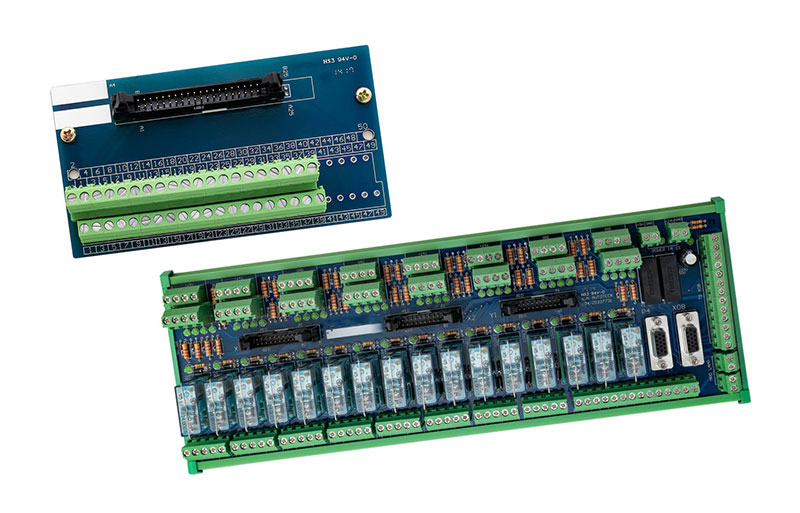
Relay Module Selection: How to Choose Between Optocoupler and Mechanical Types
1. For CNC Equipment Selection, Should You Evaluate the Load First or Noise Immunity First?
In CNC machine tools, PLC control panels, and automation equipment, relay modules are not merely signal interface components. They also directly affect system stability, wiring efficiency, and subsequent maintenance costs. Many equipment malfunctions are not caused by controller failure itself, but rather by mixed high and low potential wiring, on-site electrical noise interference, complex wiring, or improper load selection. For both procurement and design teams, if they can clearly determine at the initial stage whether the requirement is to switch heavy loads or to protect sensitive signals, the selection process becomes much clearer.
2. Mechanical Relay Modules: A Classic Solution for Load Driving Applications
1. Why Many Machine Tools Still Primarily Use Mechanical Types
The advantage of mechanical relay modules lies in their ability to use physical contacts to handle higher currents and voltages, enabling stable driving of motors, solenoid valves, pumps, warning lights, and other actuating components. For equipment that requires clear switching action and is easy for on-site maintenance personnel to diagnose, this type of module remains a highly practical standard configuration.
2. Practical Value in Field Applications
If the module itself integrates fuses, diodes, surge absorption, and LED indication design, it can not only simplify wiring but also reduce miswiring and maintenance troubleshooting time. For equipment with limited control cabinet space, high-density layout and DIN rail mounting are even more helpful in improving overall assembly efficiency. In its I/O Relay Module Interface Board series, YEU-LIAN focuses on saving wiring space, reducing human error, and improving maintenance efficiency.
3. Suitable Applications
- Applications requiring switching of higher-current or high-voltage loads
- Control of spindle peripherals, cooling systems, solenoid valves, or external power components
- Applications that emphasize industrial standard compatibility and on-site replaceability
3. Optocoupler Isolated Circuit Boards: Stronger Advantages in Signal Protection and Noise Immunity
1. The Core Value of Optocouplers Is Isolation
Optocoupler isolated circuit boards use optical signal transmission so that the input and output sides are not in direct electrical contact. This enables effective isolation between different potentials, suppression of ground loop issues, and reduction of the impact of external surges on the control board. For CNC, PLC, and various sensor signals, this isolation capability is precisely the key to improving noise immunity.
2. Advantages of High Speed and Low Noise
Compared with mechanical relays, optocoupler modules have no physical contact wear, provide faster switching speeds, and are better suited for high-frequency, low-power digital signal processing. When the equipment site simultaneously contains inverters, servo drives, motor start-stop operations, and long-distance wiring, inadequate I/O signal isolation often leads to false triggering, signal drift, or unstable communication. In such cases, the noise immunity advantage of optocoupler boards becomes more important than simple signal interfacing.
3. Suitable Applications
- High-speed I/O signal transmission and input-side protection
- Isolation of sensitive control signals in high-noise environments
- Control board designs with limited space that require high-density multi-channel integration
4. How Should Procurement Decisions Be Made? Clarify These Three Questions First
1. What Is the Load Size?
If high-power equipment must be controlled directly, mechanical relay modules should be considered first. If the application involves PLC I/O, sensors, or control signals, optocouplers are usually the more suitable choice.
2. Is On-Site Interference Severe?
If the control cabinet is located near inverters, servo systems, or large inductive loads, noise immunity is not an added benefit but a necessary condition. In such cases, optocoupler isolation should be evaluated first to prevent noise from feeding back into the main board.
3. Are Maintenance and Replacement Efficiency Important?
For equipment manufacturers and maintenance teams, whether the module supports standard rail mounting, LED status indication, common relay brands, and clear terminal layout will directly affect downtime and spare parts management efficiency. This is also why relay module selection cannot be based on a single specification parameter alone.
5. Conclusion: There Is No Absolute Best, Only the Most Suitable Configuration
In simple terms, mechanical relay modules are suitable for heavy-load switching, while optocoupler isolated circuit boards are better suited for sensitive signal protection and noise immunity. For CNC machinery manufacturers and automation equipment procurement teams, the best approach is usually not choosing one over the other, but configuring them according to the roles of different circuits within the system. YEU-LIAN has long been deeply engaged in the machine tool and industrial control sectors. In addition to providing module solutions such as Relay Module for CNC PLC PCB and Optocoupler Insulated Circuit Board, it can also deliver customized designs based on equipment interfaces, wiring methods, and integration requirements, helping enterprises achieve a better balance among stability, maintainability, and implementation efficiency.