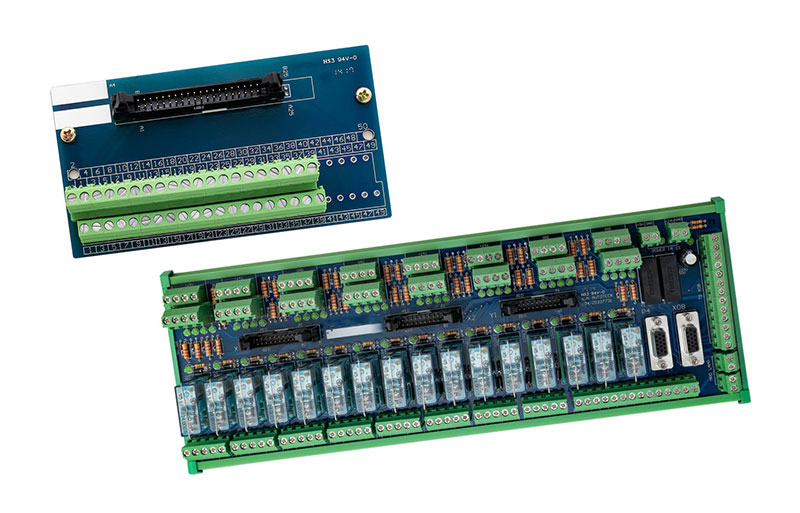
How Modular I/O Interface Boards Reduce Wiring
1. Why Wiring Often Becomes a Bottleneck in Machine Delivery Schedules
In the electrical control assembly process of CNC machines and automation equipment, the most time-consuming part is often not component installation, but back-end wiring. From sensors, limit switches, buttons, and handwheels to the interconnection of I/O signals among relays, drives, and controllers, traditional point-to-point wiring not only requires extensive manual verification of terminals and wire numbers, but also increases the risk of errors due to confined on-site space and crossed wiring. For equipment manufacturers and procurement units, longer wiring time usually means compressed delivery schedules, higher machine commissioning costs, and more difficult subsequent maintenance.
This is also why more and more machine builders are adopting modular I/O interface boards. Their core value is not only faster wiring, but also transforming originally scattered and error-prone wiring processes into a more standardized, repeatable, and maintainable modular architecture.
2. The Difference Between Traditional Wiring and Modular Design
Under a traditional wiring model, engineers must route each field signal back to the control side and then connect them point by point to the PLC, control board, or interface board according to the drawings. A single mistake in terminal numbering or reversed wire sequence can lead to repeated troubleshooting during machine commissioning. As the number of machine axes increases and peripheral functions expand, wiring complexity rises rapidly.
A modular I/O interface board, by contrast, uses standardized connectors, backplane layout, and centralized interfacing concepts to organize and partition commonly used signals first, then connect them to the main control system through a unified interface. For the assembly side, processes that originally required extensive manual interpretation and one-by-one wire matching become a clearer workflow of module installation and connector insertion. Based on practical experience, wiring work that previously required 2 to 3 days can often be shortened to less than 1 day. This is especially noticeable when multiple machine models are produced in parallel, with wiring reduction efficiency gains of up to 50%.
3. Technical Highlights of YEU-LIAN Modular I/O Interface Boards
YEU-LIAN has long focused on CNC and industrial control interface integration. The design priorities of its modular I/O interface boards go beyond wiring convenience to place greater emphasis on field stability and practical maintenance. Common configurations include optocoupler isolation, overvoltage protection, and LED status indication, helping engineers quickly identify signal status during startup, testing, and maintenance while reducing troubleshooting time caused by misjudgment.
- Standardized connectors and modular backplane design make wiring processes more consistent, making them suitable for repeated assembly and mass production.
- Supports different I/O point configurations for flexible arrangement according to equipment functions and control requirements.
- Can be integrated with relay modules, control panels, and electrical control cabinets to shorten system assembly and testing processes.
- DIN rail mounting allows easy installation inside electrical control cabinets while maintaining wiring neatness and convenient disassembly and reassembly.
4. Practical Application Scenarios in CNC and Automation Equipment
Taking multi-axis CNC machines as an example, if handwheel signals, limit signals, button inputs, warning light signals, and servo-related I/O are handled separately, field wiring can easily become disorganized, and quick fault localization during maintenance becomes difficult. After adopting modular I/O interface boards, multiple groups of signals can be centrally managed, making the relationship between the main control board and field components clearer. This is highly beneficial for both new machine assembly and retrofit projects for existing machines.
In automated production lines, packaging equipment, or peripheral stations, procurement and technical units are usually more concerned with future expansion flexibility. When the system needs to add sensors, warning modules, or actuating elements, a modular architecture can reduce the need for extensive rewiring and also facilitate integration among IPCs, PLCs, and power distribution panels. This approach not only saves current labor hours, but also reduces future retrofit and maintenance costs.
5. Five Key Benefits of Choosing Modular I/O Interface Boards
- Saves wiring time and labor costs while improving complete machine shipment efficiency.
- Reduces the risk of incorrect terminal connections, wire sequence confusion, and on-site rework.
- Improves signal management clarity and helps maintain stable system operation.
- Facilitates subsequent maintenance, fault diagnosis, and function expansion.
- Creates a neater electrical control cabinet interior, which is also more favorable for quality management and customer acceptance.
6. From Reduced Wiring to More Efficient Equipment Integration
For CNC machine builders and automation equipment procurement personnel, the value of modular I/O interface boards is not limited to the cost of a single component. It is a comprehensive consideration of overall assembly efficiency, maintenance convenience, and future expansion flexibility. If equipment models are diverse, delivery schedules are tight, and field maintenance demands are high, modular design usually offers better long-term benefits than traditional point-to-point wiring.
YEU-LIAN can provide planning for I/O point counts, connector types, and integration methods based on equipment application requirements. It can also be combined with relay modules, customized operation panels, and electrical control cabinet contract manufacturing services to help customers build more efficient and easier-to-maintain control systems. If you are evaluating wiring reduction and modular solutions, it is recommended to start by assessing the signal quantity, maintenance frequency, and expansion requirements of your existing machines in order to select a more suitable I/O architecture.