What Should You Do If a CNC Electrical Control Cabinet Overheats? Key Points for Thermal Management Layout and Temperature Resistance
1. Why Electrical Control Cabinet Overheating Must Not Be Overlooked
For CNC machinery manufacturers and automation equipment procurement personnel, electrical control cabinet overheating is not merely a surface-level issue of elevated temperature. It is a critical risk that affects equipment stability, production cycle time, and subsequent maintenance costs. When servo drives, power supplies, relay modules, and I/O modules operate for extended periods in a high-heat environment, they are more likely to experience protective shutdowns, signal abnormalities, premature component aging, and even complete machine failure. If the internal cabinet temperature remains out of control over the long term, the problem is often not limited to a single failed part, but rather a simultaneous decline in overall reliability.
2. Common Sources of Overheating and Their Actual Impact
Electrical control cabinet overheating usually results from several factors occurring at the same time: continuous heat generation from high-power servo drives and inverters, high-frequency switching of relays, overly compact cabinet space, high ambient temperature, and reduced intake and exhaust efficiency caused by dust accumulation in filters. Some machines may be equipped with fans, but without a clearly defined airflow path for intake, exhaust, and heat source zoning, hot air can still circulate and remain trapped inside the cabinet. When temperatures approach the upper temperature resistance limits of components, common industrial electronic components may begin to age significantly faster at approximately 70 to 85 degrees C, affecting contact life, capacitor stability, and control signal quality.
3. Layout Principles for Electrical Control Cabinet Thermal Management
Effective electrical control cabinet thermal management cannot rely solely on adding more fans. It must begin with overall thermal flow design. First, establish an airflow path from bottom to top and from cooler zones to hotter zones, so that cool air can enter and hot air can be discharged smoothly. Second, appropriately separate high-heat-generating components from more sensitive areas such as PLCs, communication modules, and terminal blocks to prevent localized heat buildup. Third, estimate cooling requirements based on equipment power, cabinet size, and site environment, then select suitable fan airflow, filter resistance, and vent locations. If the site has heavy dust or oil mist, protection and maintenance convenience must also be considered to avoid increasing contamination risk after improving heat dissipation.
4. Recommendations for Component Temperature Resistance and Selection
For component selection, industrial-grade components should be prioritized, and actual operating temperature should be confirmed rather than relying only on catalog specifications. During engineering design, in addition to focusing on the temperature resistance of individual components, attention should also be given to the cumulative effect caused by nearby heat sources inside the cabinet. For example, if terminals or an I/O board are placed directly above a drive, the actual heat exposure is often higher than the measured point indicates. Temperature monitoring sensors and industrial LED warning lights can also be integrated to alert maintenance personnel immediately when the cabinet temperature rises abnormally, allowing ventilation, filter, or load issues to be addressed before a failure occurs.
5. YEU-LIAN’s Practical Integration Approach
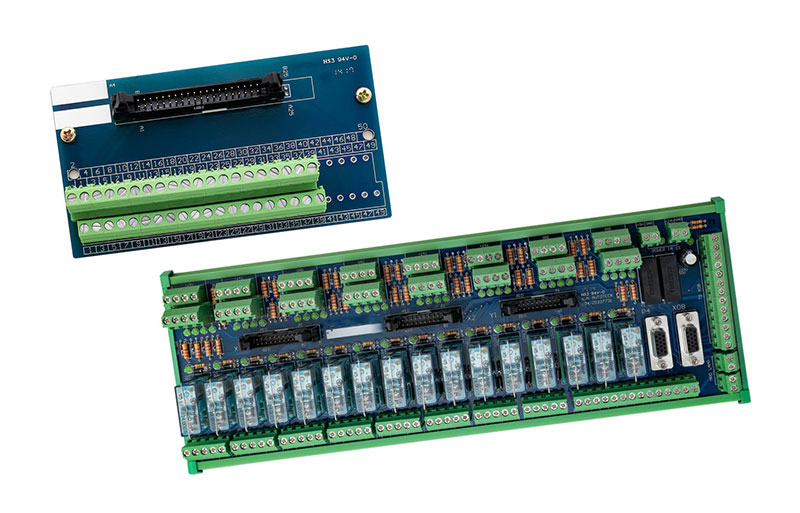
In electrical control cabinet contract manufacturing and integration, YEU-LIAN plans thermal management based on the customer’s machine type, load conditions, and installation environment, evaluating cabinet layout, airflow design, and module selection together as a complete solution. Industrial-grade fans, thermal management modules, temperature monitoring components, relay modules, I/O modules, and CNC operation panels can all be integrated, while also considering wiring maintainability and future service efficiency. For legacy machine retrofits, high-mix low-volume customization, or new automation equipment projects, layout direction can also be adjusted according to on-site constraints, helping customers achieve a balance among stability, maintenance convenience, and implementation cost.
6. Conclusion: Solve the Heat Issue First, Then Talk About Stable Production
CNC electrical control cabinet overheating is often not the result of a single component quality issue, but rather the combined effect of heat dissipation paths, component temperature resistance, and internal cabinet layout. If electrical control cabinet thermal management is included in the evaluation at the design stage, and suitable temperature-resistant components and monitoring mechanisms are selected, the risks of unexpected downtime and maintenance can be reduced effectively. If you are evaluating a new machine model’s electrical control cabinet design, improving the cooling performance of existing equipment, or need to integrate I/O modules, relay modules, and operation panels, YEU-LIAN can provide one-stop planning and customized support that is better aligned with real industrial site requirements.