How Traditional Operator Panels Can Be Networked in the Era of Industry 4.0
1. After the Adoption of Industry 4.0, Legacy Panels Are No Longer Just Operator Interfaces
For CNC machine builders and automation equipment manufacturers, Industry 4.0 has moved beyond conceptual discussion to purchasing and implementation decisions. Whether equipment can connect reliably to networks and return usable data is gradually affecting production line management, after-sales service, and the efficiency of future plant expansion. However, many sites are still using traditional operator panels that have been in service for 10 or even 20 years. These systems are typically designed primarily for local control. While the machines themselves may still function properly, under an IoT architecture they often lack data exchange capabilities, making it impossible to centrally monitor machine status, difficult to trace abnormalities, and leaving maintenance dependent on manual experience. When factories seek to integrate MES, SCADA, or cloud platforms, the issue is often not that the machines are unusable, but that the legacy panels cannot indicate what is happening on the equipment in real time.
2. Why Traditional Operator Panels Must Be Networked
If traditional panels continue to operate independently, the most immediate consequence is the creation of data islands. Information such as equipment utilization, machining cycle time, alarm records, manual operation switching, and causes of downtime remains scattered across individual machines, making it difficult for managers to assess production bottlenecks using a unified logic or establish cross-machine maintenance standards. For procurement and equipment management teams, this affects not only management efficiency but also retrofit costs. When companies later seek to implement higher-level intelligent analytics, if the underlying equipment lacks basic IoT connectivity, they must redo communications, wiring, and signal consolidation. In other words, networking traditional panels is not about achieving a smart factory in one step, but about first giving existing equipment the foundation to be visible, manageable, and integrable.
3. Three Common Challenges in Upgrading Legacy Panels
First, communication protocol incompatibility. Many older machines still rely on RS-232, RS-485, or proprietary in-house signal architectures, creating a clear gap with modern environments such as Ethernet, OPC UA, and MQTT. Second, hardware constraints. Legacy machine panels often have limited internal space and insufficient controller board processing capability, while also requiring consideration of oil contamination, dust, vibration, heat dissipation, and electromagnetic interference. Stable connectivity cannot be achieved simply by adding a communication board. Third, cybersecurity and return-on-investment pressures coexist. Small and medium-sized manufacturers generally do not want to replace entire machines extensively just to enable connectivity, nor do they want to introduce new risks into existing production lines. Therefore, upgrade solutions must balance phased implementation, ease of maintenance, and reasonable cost.
4. Practical and Feasible Connectivity Approaches
In practice, networking traditional operator panels usually does not require full replacement, but rather a layered retrofit based on equipment conditions. A common approach is to first install an IoT gateway to translate existing I/O, alarm points, or serial communication data into formats readable by higher-level systems. If the panel itself has aged or become functionally inadequate, it can then be upgraded with a customized operator panel that preserves the machine's original operating habits while adding new display, pushbutton, indication, and communication capabilities. If the equipment is undergoing a full-machine retrofit or control cabinet rewiring, a modular electrical control cabinet integration approach can be adopted to plan the controller board, relays, terminals, I/O, and external communications all at once. The key to these methods is not pursuing the latest buzzwords, but enabling existing equipment to complete its connectivity infrastructure with minimal downtime and within a controllable budget.
5. How YEU-LIAN Helps Customers Complete Upgrades
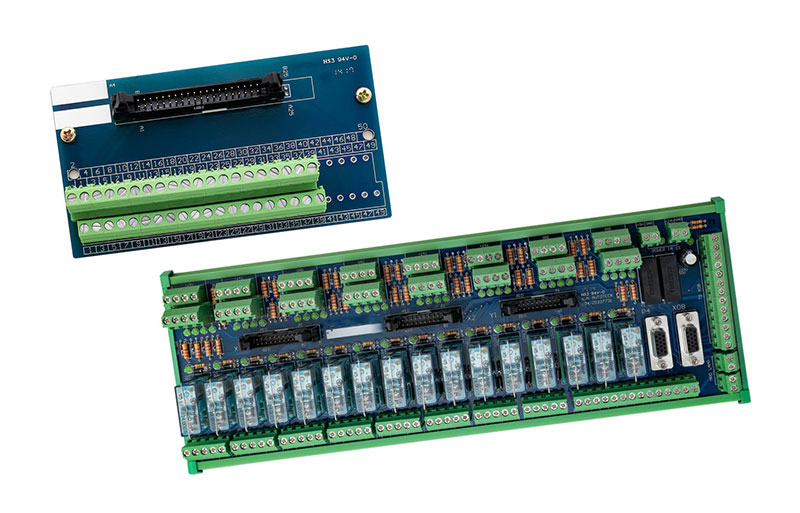
Since entering the industrial electronics field in 1989, YEU-LIAN has long served the machine tool and automation equipment sectors, with extensive familiarity in legacy machine compatibility, wiring practices, and operator interface integration requirements. For connectivity upgrades, YEU-LIAN can provide a complete solution ranging from customized CNC operator panels, MPG electronic handwheels, relay modules, and I/O modules to electrical control cabinet contract manufacturing. For example, I/O modules using opto-isolation design help reduce the impact of on-site electromagnetic interference on signal quality. Modular relay configurations make protection circuits and maintenance easier to manage. If operators still need to retain manual intervention procedures, integrating MPG units with the control interface also allows operation signals in manual mode to be included in data collection. For equipment manufacturers, this means they do not have to choose between on-site reliability and digitalization, but can expand step by step according to actual application needs.
6. What Procurement and Equipment Teams Should Confirm Before Implementing Connectivity
Before planning a connectivity retrofit, it is recommended to review three items first. First, determine what data needs to be collected, such as machine power status, abnormal alarms, machining time, and production counts, to avoid deploying hardware before defining clear data usage. Second, confirm the on-site control architecture and communication interfaces, including the existing PLC, controller brand, panel dimensions, power conditions, and cabinet space, as these factors will directly affect the retrofit approach. Third, reserve flexibility for cybersecurity and future expansion, including network segmentation, access control, edge computing, and future system integration requirements. The earlier these conditions are clarified, the more rework can be avoided later, and the easier it becomes to evaluate the actual return on investment of the connectivity solution.
7. Conclusion: Intelligent Manufacturing Starts with Basic Connectivity
The core of Industry 4.0 is not replacing all equipment at once, but enabling shop-floor equipment to generate, transmit, and utilize data reliably. For manufacturers that still operate a large number of existing machines, networking traditional operator panels is the most pragmatic first step. With an appropriate IoT architecture, modular control components, and customized integration capabilities, legacy equipment can also connect progressively to the pace of smart manufacturing. Drawing on many years of experience in machine tools and automation control, YEU-LIAN helps customers complete upgrade planning from operator interfaces to electrical control integration without excessively increasing cost and risk, laying a more stable foundation for subsequent monitoring, maintenance, and production line optimization.