How EMC/EMI Affects Electronic Handwheel Signals
1. Introduction: Why Electronic Handwheels Are Especially Susceptible to Interference
During the setup and adjustment processes of CNC machines, grinders, lathes, and various automation equipment, the MPG electronic handwheel is one of the most direct and heavily relied upon human-machine interfaces for on-site operators. It is responsible for converting rotational motion into A/B phase pulse signals, which are then translated by the controller into precise axial displacement. As long as the signal remains stable, operators can perform fine feed adjustments, tool setting, and position correction with precision. However, if high-frequency noise, poor grounding, or inadequate wiring design exists on site, issues such as skipped counts, misreading, and pulse loss may occur even when the handwheel itself is not defective, directly affecting machining accuracy and changeover efficiency while increasing the risks of downtime and scrap.
2. The Difference Between EMC and EMI
EMC refers to a device's ability to operate normally within its electromagnetic environment without causing unacceptable interference to other equipment, while EMI refers to the actual source of electromagnetic energy that causes interference. For electronic handwheels, the issue is not simply whether noise is present, but whether the entire system can withstand it. When the handwheel output signal amplitude is insufficient, cable shielding is incomplete, or the I/O side lacks proper isolation, the controller is more likely to misinterpret external interference as valid pulses, or to experience jitter and missed readings when actual operating pulses are received.
3. Common Sources of Interference in Factory Environments
In CNC and automation equipment environments, interference is usually not caused by a single factor, but by multiple types of equipment acting simultaneously. Common sources include inverter-driven spindles and servo motors, high-frequency switching power supplies, welding equipment, solenoid valves, high-current contactors, and wireless communication modules. This interference can enter the control system through conduction, radiation, and induction. For example, when handwheel signal cables run too close in parallel with power lines, inductive coupling is likely to occur. Improper common-ground design may also create ground loops, allowing interference to be amplified through the system circuit.
4. How Electronic Handwheel Signal Abnormalities Typically Occur
In practice, many sites observe the results first and only then trace back to the cause. For example, during fine feed adjustment, the machine may occasionally move one extra increment; during high-speed cutting, dimensional compensation may respond inconsistently; or when a welding machine or other high-power equipment starts up, the controller may trigger alarms, falsely activate an emergency stop, or even cause axial position deviation. These phenomena are often mistaken for unstable handwheel quality, but the real root cause usually lies in the overall signal chain, including the encoder signal output method, the anti-interference capability of the receiving end, wiring routes, terminal crimping quality, and grounding strategy. For procurement teams and equipment designers, simply replacing a single component without simultaneously checking the system architecture usually makes it difficult to eliminate the problem at its source.
5. Key Points for Effective Noise Immunity Design
Truly effective noise immunity design should be planned from three aspects simultaneously: source suppression, transmission path blocking, and receiving-end protection. At the source, filters, suppression components, and improved driver configuration can be used to reduce noise energy. For the transmission path, twisted-pair or shielded cables are recommended, with sufficient separation maintained between handwheel signal lines and power or motor cables; if necessary, independent metal conduits or cable ducts should be used. At the receiving end, differential output, optocoupler isolation, filtering circuits, and surge protection can improve the system's ability to identify valid pulses. Where equipment space permits, equipotential grounding and single-point grounding principles can also effectively reduce hidden interference caused by ground loops.
6. What to Watch for During Procurement and Design
For machine builders and automation equipment procurement personnel, anti-interference measures should not be treated only as corrective actions after abnormalities occur, but should be incorporated at the early stages of product selection and development. When evaluating electronic handwheels and peripheral modules, priority should be given to confirming whether they support differential signals, isolation design, modular wiring, and complete grounding planning, while also requiring suppliers to provide relevant EMC validation evidence or practical application experience. If the project involves retrofitting older machines, mixed controller systems, or complex on-site interference sources, the handwheel, I/O modules, wiring, and control cabinet should be regarded as one integrated system rather than procured separately. Only in this way can the risks of repeated maintenance, misdiagnosed faults, and post-delivery instability be reduced.
7. YEU-LIAN's Practical Integration Approach
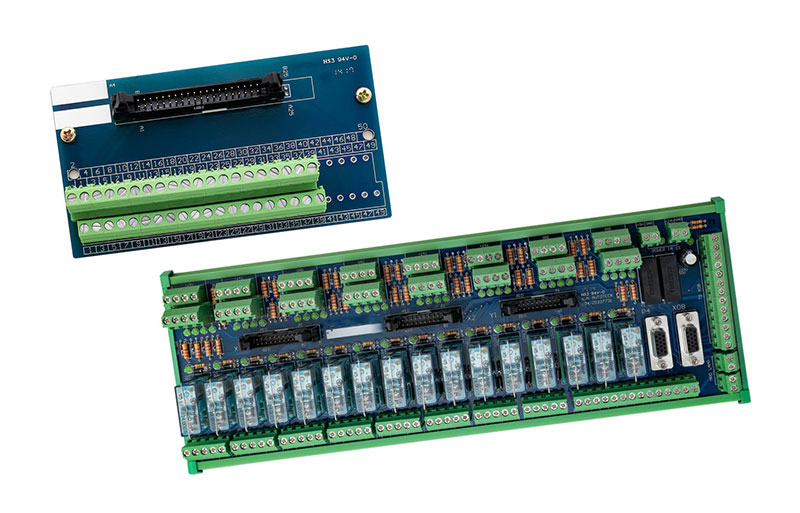
YEU-LIAN has long served the machine tool and automation equipment sectors, integrating common on-site noise immunity requirements into MPG electronic handwheels, customized operator panels, I/O modules, relay modules, and control cabinet solutions. The focus is not merely on supplying individual components, but on helping customers review signal output, interface integration, module wiring, and cabinet grounding as a whole to improve control signal stability and maintenance convenience. For equipment manufacturers that prioritize reliability, compatibility, and retrofit efficiency, this application-driven design approach often reduces implementation risk more effectively than evaluating specifications alone.
8. Conclusion: Address Interference Risks Before Downtime Occurs
Although EMC and EMI may appear to be invisible issues, they have a profound impact on electronic handwheel signal quality and machine stability. When machining accuracy, setup efficiency, and equipment safety all depend on correct pulses, noise immunity design is no longer just an electrical detail, but part of overall equipment reliability. If your machine is experiencing unstable handwheel signals, unintended operation, or on-site interference that is difficult to isolate, YEU-LIAN can help evaluate wiring, modules, and integration methods based on actual application conditions, enabling the system to maintain more stable control performance in complex factory environments.